If you have trouble breathing through your nose, you have probably already tried the obvious things: allergy medicine, nasal sprays, maybe adhesive nasal strips at night. When those do not work, the next question is usually “Do I need surgery?” The better question is “What exactly is blocking my nose?”
Nasal obstruction is a symptom, not a diagnosis. There are four main structural reasons a nose stays blocked, and they are treated very differently. A treatment aimed at the wrong cause tends to fail, which is why some patients have had a septoplasty or years of allergy treatment and still cannot breathe well. This page explains how Dr. Pablo Stolovitzky, a rhinologist with more than 30 years of experience who sees patients in Atlanta (Center Pointe), Decatur and Snellville, sorts out the cause and matches it to the right treatment.
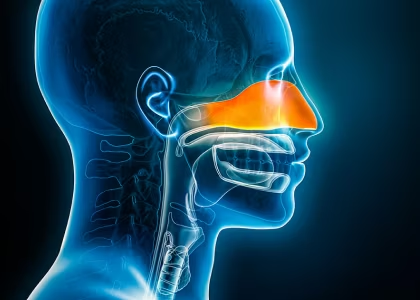
Four causes of a blocked nose
The nasal septum
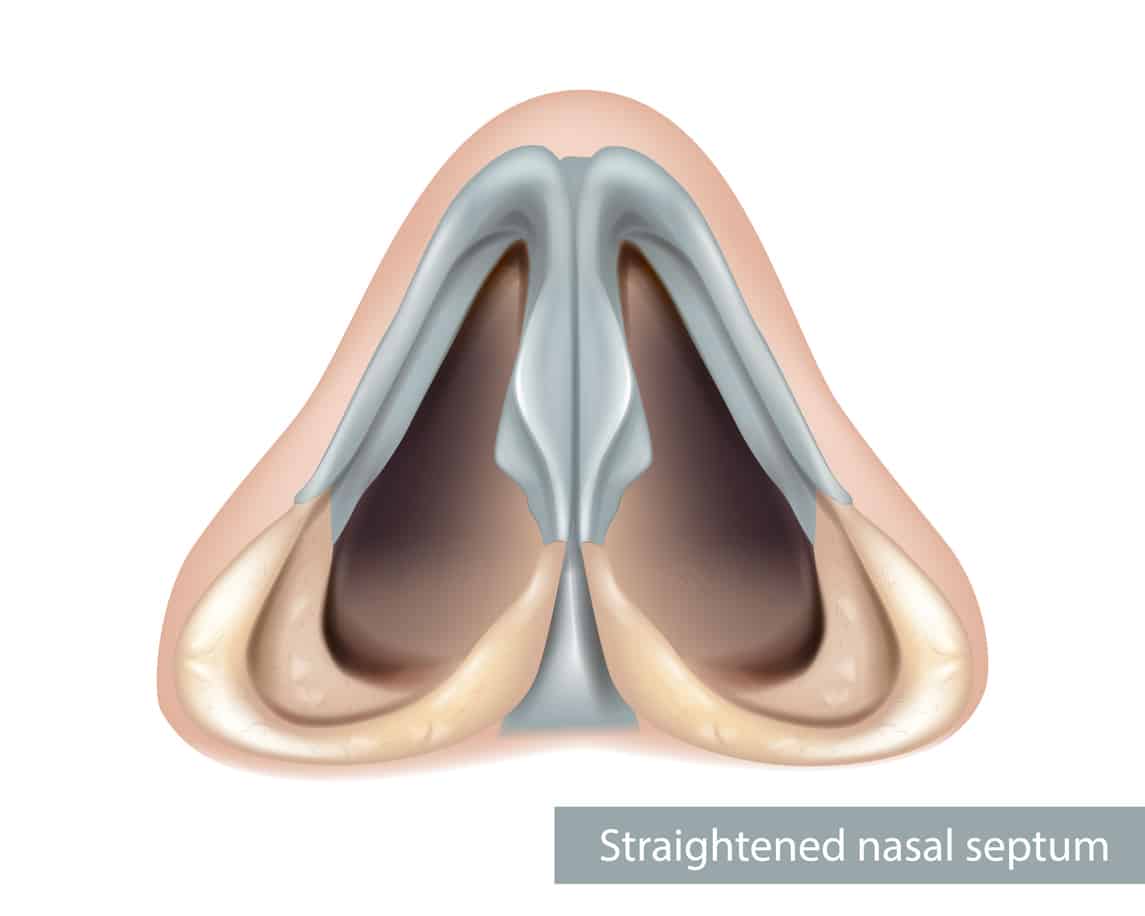
The septum is the wall of cartilage and bone that divides the two sides of the nose. Some degree of deviation is extremely common, estimated at up to 80 percent of adults, and most people with a deviated septum breathe normally. A deviation matters only when it narrows the airway enough to cause symptoms, typically a blockage that is worse on one side and does not change much with sprays. Learn more about deviated septum.
The inferior turbinates
The turbinates are shelf-like structures inside the nose that warm and humidify the air you breathe. They swell in response to allergies, irritants, infection, or long-term use of decongestant sprays. Enlarged turbinates usually cause blockage on both sides that shifts from one side to the other over the course of the day and often improves, at least temporarily, with a steroid spray. Learn more about turbinate reduction.
The nasal valve
The nasal valve is the narrowest part of the nasal airway, about a centimeter inside the nostril. It is a small triangular passage bounded by the septum on the inside, the upper sidewall cartilage (the upper lateral cartilage) on the outside, the front of the inferior turbinate behind, and the floor of the nose below. Where the sidewall cartilage meets the septum, the angle is normally only 10 to 15 degrees, so a very small change here has a large effect on airflow. This short segment accounts for about half of the total resistance to breathing through the nose.
Nasal valve obstruction takes two forms:
- Static narrowing. The angle between the sidewall cartilage and the septum is narrower than normal, so the passage is tight all the time. This is the more common form. It can be present from birth or develop after an injury or previous nasal surgery.
- Dynamic collapse. The sidewall cartilage is weak or has lost support, so it pulls inward when you breathe in. The faster the air moves, the more the wall collapses, which is why breathing can feel worst during exercise.
Many patients have both. Nasal valve obstruction is the cause of a blocked nose most often overlooked, in part because it cannot be seen well on a CT scan and is easy to miss on a quick look into the nostril.
Clues that point toward the nasal valve include blockage that is worse during exercise or when lying down, breathing that improves when you gently pull your cheek outward (a self-test many patients discover on their own), and relief from adhesive nasal strips. The American Rhinologic Society recognizes nasal valve collapse as a distinct diagnosis that can occur with or without a deviated septum. Read more about how nasal valve collapse affects breathing.
Inflammation: allergies, chronic rhinitis, and nasal polyps
Swelling of the nasal lining from allergies, non-allergic chronic rhinitis , or chronic sinusitis can block the nose on its own or make a structural problem worse. Nasal polyps are a separate, treatable cause that also reduces the sense of smell. Inflammation is usually treated with medication first, and when a structural problem is also present, the two are often treated together.
Many patients have more than one of these. A common combination is a mildly deviated septum, enlarged turbinates, and a weak nasal valve. Treating only one of the three gives partial relief.
How the cause is identified
Diagnosis is based on your history and a careful office examination, not on imaging alone.
- History. Whether the blockage is one-sided or both, constant or changing, worse at night or with exertion, and what has and has not helped.
- Examination. Dr. Stolovitzky examines the septum, the turbinates and the nasal valve while you breathe, before and after a decongestant spray, and watches for collapse of the sidewall when you breathe in. He then performs the modified Cottle maneuver: a small, smooth instrument is placed just inside the nostril to hold the nasal valve open at its normal angle, and you are asked what percentage your breathing improves. A large improvement points to the nasal valve as the main cause.
- Nasal endoscopy. A thin, lighted camera shows the nasal valve, the septum, the turbinates and the area behind them in high-resolution detail, identifies polyps or sinus drainage, and records images for your chart and for comparison after treatment.
- Symptom scoring. A validated questionnaire, the NOSE scale, measures how much the obstruction affects daily life and allows improvement to be tracked after treatment. You can score yourself below.
- CT scan. Ordered when chronic sinusitis or polyps are suspected. It is not required to diagnose nasal valve collapse.
Score your own nasal obstruction (NOSE scale)
The NOSE scale (Nasal Obstruction Symptom Evaluation) is the questionnaire used in clinical trials of nasal valve treatments, including the trials Dr. Stolovitzky led. Thinking about the past month, rate each item from 0 (not a problem) to 4 (a severe problem):
- Nasal congestion or stuffiness
- Nasal blockage or obstruction
- Trouble breathing through my nose
- Trouble sleeping
- Unable to get enough air through my nose during exercise or exertion
Add the five numbers and multiply by 5 for a score out of 100. Scores of 5 to 25 are mild, 30 to 50 moderate, 55 to 75 severe, and 80 to 100 extreme. Patients in the office-procedure trials typically started with scores of 55 or higher. A score in the moderate range or above, especially one that has not improved with sprays, is a good reason to be evaluated.
Treatment options, from least to most involved
Saline rinses, nasal steroid spray, allergy treatment
- Best for: inflammation of the lining, turbinate swelling
- Where: at home
- Downtime: none
Nasal dilator strips or internal dilators
- Best for: temporary relief of nasal valve narrowing; also a useful diagnostic clue
- Where: at home
- Downtime: none
Radiofrequency turbinate reduction
- Best for: enlarged turbinates that no longer respond to sprays
- Where: office, local anesthesia
- Downtime: a day or two
VivAer temperature-controlled radiofrequency
- Best for: nasal valve narrowing or collapse (static or dynamic) without a major septal deviation
- Where: office, local anesthesia
- Downtime: a day or two
LATERA absorbable nasal implant
- Best for: dynamic nasal valve collapse (the sidewall pulls in on inhalation)
- Where: office, local anesthesia
- Downtime: a few days
Septoplasty
- Best for: a deviated septum that causes symptoms
- Where: outpatient surgery center, under anesthesia
- Downtime: about one week
Surgical nasal valve repair (cartilage grafts, often called functional rhinoplasty)
- Best for: severe or fixed valve collapse, collapse after previous rhinoplasty, or when office options are not appropriate
- Where: outpatient surgery center, under anesthesia
- Downtime: one to two weeks
Procedures are frequently combined. Septoplasty and turbinate reduction are often done together, and nasal valve treatment can be added to either.
Office radiofrequency treatment of the nasal valve (VivAer)
This procedure uses controlled low-temperature radiofrequency energy to remodel and stiffen the tissue at the nasal valve so the sidewall resists collapse. It is performed through the nostril with no incisions and no change to the outside appearance of the nose. In a randomized, controlled trial of patients with severe nasal obstruction due to nasal valve collapse, patients reported large improvements in nasal breathing that were maintained three years after a single treatment, with no serious device-related complications reported. Learn more about the VivAer procedure.
Absorbable nasal implant (LATERA)
A small absorbable implant is placed inside the nasal sidewall through a tiny entry point just inside the nostril, where it supports the cartilage while the body forms its own supporting tissue around it. The implant dissolves over about 18 months. In a randomized trial comparing the implant with a sham procedure, patients who received the implant had significantly greater improvement in breathing, and that improvement persisted through two years of follow-up. Dr. Stolovitzky was the first author of that trial. Learn more about LATERA.
Surgical repair
When the septum is significantly deviated, or when the nasal valve has collapsed because of weak or missing cartilage, surgery in an outpatient surgery center remains the most reliable treatment. Septoplasty straightens the septum from inside the nose. Nasal valve repair uses small cartilage grafts to rebuild sidewall support. Learn more about nasal surgery for airway obstruction.

What the evidence does and does not show
Septoplasty and turbinate reduction have decades of supporting experience. The office radiofrequency procedure and the absorbable implant are both supported by randomized controlled trials with follow-up of two to three years, which is unusual for office-based procedures and is the main reason Dr. Stolovitzky offers them. Head-to-head comparisons between the office procedures and surgical valve repair are limited, and durability beyond three years is still being studied. Insurance coverage for the office procedures varies by plan, and some insurers continue to classify them as investigational; the office verifies your coverage before scheduling.
Dr. Stolovitzky also tracks his own results. In a series of 35 patients treated with VivAer in his office, presented at the Pan-American Congress of Otolaryngology in 2025, the average NOSE score fell from 70 before treatment to 25 three months afterward, and 34 of the 35 patients improved by at least 20 percent. These are results from one practice and have not yet been published in a peer-reviewed journal, but they are consistent with the randomized trial.
Dr. Stolovitzky’s role in this research

Dr. Stolovitzky served as first author of the sham-controlled randomized trial of the absorbable nasal implant (International Forum of Allergy & Rhinology, 2019) and of the earlier prospective study that preceded it (Laryngoscope, 2018), and he lectures internationally on the evaluation of nasal airway obstruction. A full list is available on the Publications page.
Frequently asked questions
I have a deviated septum. Do I need surgery?
Only if it is causing symptoms. Most people with a deviated septum breathe normally. If your blockage is on both sides and changes with sprays, the septum is probably not the main problem.
Nasal strips help me breathe at night. Does that mean I have nasal valve collapse?
It is a strong clue but not a diagnosis. Strips hold the sidewall open, so relief suggests the valve is involved. An office examination confirms it and checks for other causes.
Is nasal valve collapse the same as a deviated septum?
No. The septum is the wall in the middle of the nose. The nasal valve is the narrow opening just inside the nostril, bounded by the septum, the sidewall cartilage, the front of the turbinate and the floor of the nose. A deviated septum narrows the middle of the nose; nasal valve obstruction narrows that opening, either all the time or when you breathe in. The two often occur together, which is why both are examined before a treatment is chosen.
Will an office procedure change the shape of my nose?
The radiofrequency procedure and the absorbable implant are designed not to alter the outside appearance of the nose. Surgical valve repair can slightly change the look of the sidewall, which is discussed in advance.
I already had a septoplasty and still cannot breathe. Why?
The most common reason is a nasal valve problem that was not addressed, followed by turbinate enlargement or ongoing inflammation. A repeat evaluation usually finds the cause.
How long does recovery take?
Office procedures: most patients return to normal activity within a day or two, with some congestion for one to two weeks. Septoplasty or surgical valve repair: about one week away from work, with breathing improving over several weeks as swelling settles.
Are these procedures covered by insurance?
Septoplasty and turbinate reduction are generally covered when medically necessary. Coverage for the office radiofrequency procedure and the absorbable implant varies, and some plans still consider them investigational. The office checks your specific plan before anything is scheduled.
Next steps
If your nose has stayed blocked despite medication, an evaluation can identify which of the four causes is responsible and whether an office procedure or surgery is the better fit. Dr. Stolovitzky sees patients at ENT & Allergy of Georgia’s Center Pointe office in Atlanta (1100 Johnson Ferry Road NE, Suite 420) and in Decatur and Snellville. To request an appointment with Dr. Stolovitzky, use the online scheduler or call (404) 921-5474.
Call Dr. Pablo Stolovitzky for more information or to schedule an appointment.